Why your AI feature is confidently wrong
Reduce wrong AI answers by checking sources, limiting what the feature can do, and deciding when it should ask a question or send a request to a person.
On this page
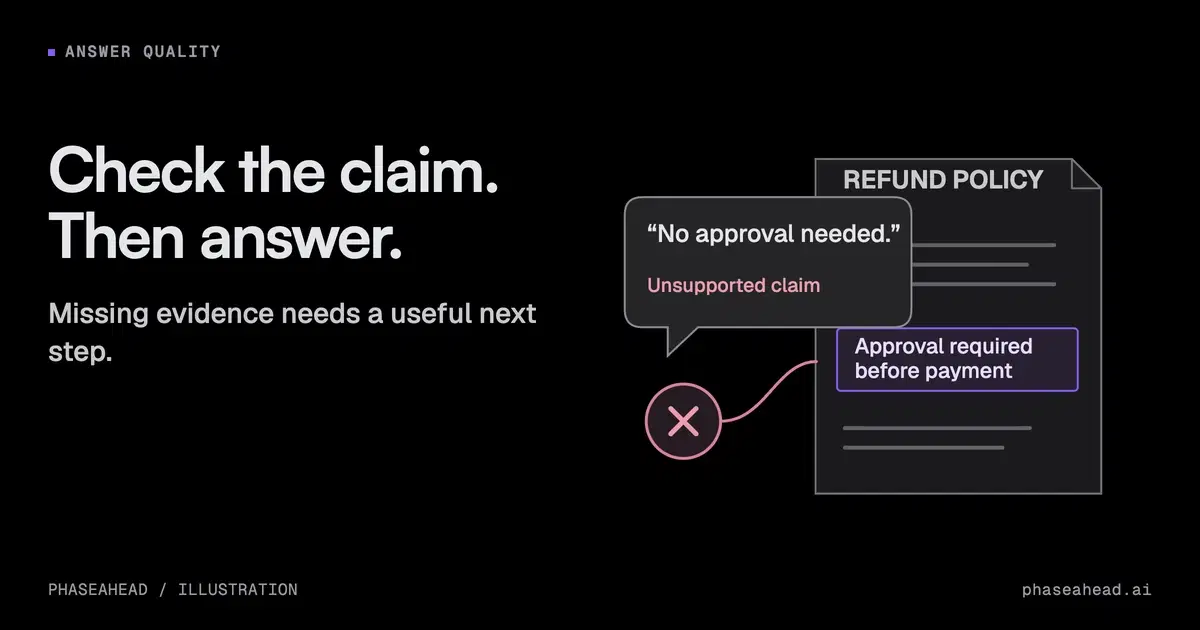
A customer asks whether they qualify for a refund. The AI answers clearly, cites a policy, and gets the eligibility rule wrong. The problem is now a customer promise your team must resolve.
Before changing the model, identify how the wrong answer reached the user. Was the policy missing, outdated, retrieved incorrectly, or misread? Did the product require an answer when it should have asked a question? Each failure needs a different fix.
We would first narrow the feature's authority: what it may answer, which evidence it needs, and when it must ask for help. Then test whether a model change improves the remaining errors.
TL;DR Trace a wrong answer back to its evidence before changing the model. Check sources, enforce action limits in code, and give missing or conflicting information a clear route to clarification or review.
Define the evidence a correct answer needs
For account-specific questions, use the current system of record. For policy questions, use the policy that applies to that customer and date. A model's general knowledge cannot confirm the state of a particular order.
Record source ownership and update rules. If nobody maintains the refund policy, adding retrieval only makes the stale policy easier to find.
OpenAI's research on hallucinations discusses how training and evaluation incentives can reward guessing. In a product, make missing information a supported outcome. The interface should allow a useful clarification or an explicit inability to verify the answer.
Check retrieval and answer generation separately
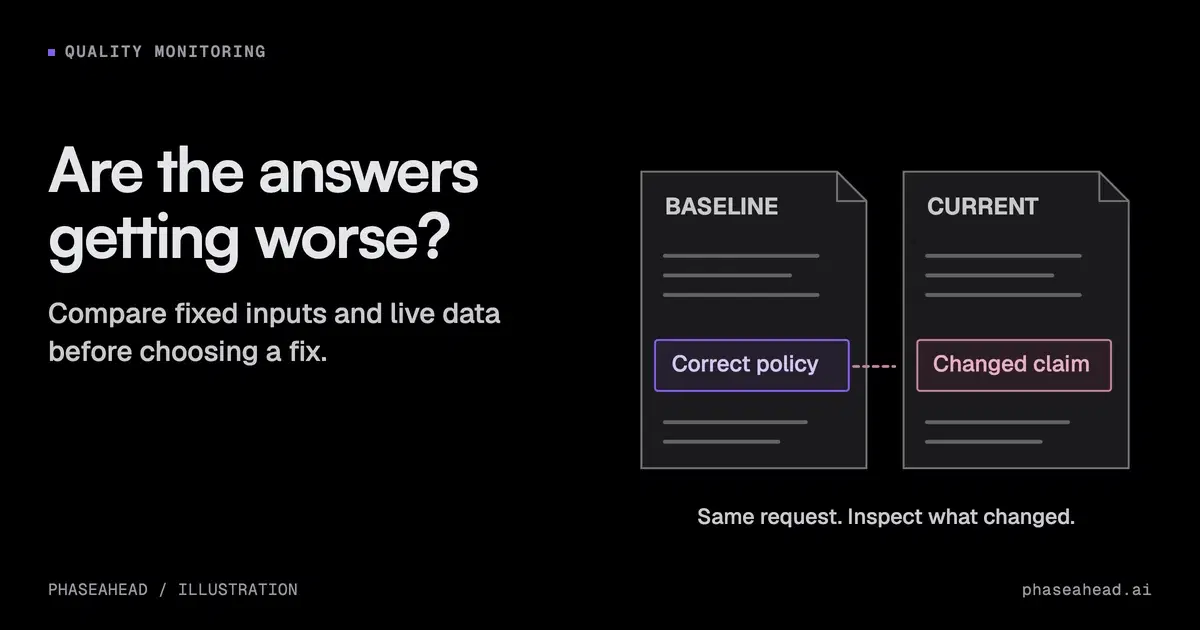
When using retrieval, inspect whether the relevant authorized passage reached the model. Then check whether the answer accurately reflects it. Those are separate tests. If the answer cites a source, also check that the user can open it and is allowed to see it.
Even an answer based on a source can omit an exception or mix rules from different versions. Stanford's research on legal AI tools found errors in the products it tested despite retrieval. Those results concern that benchmark and those tools, not a universal error rate for AI products.
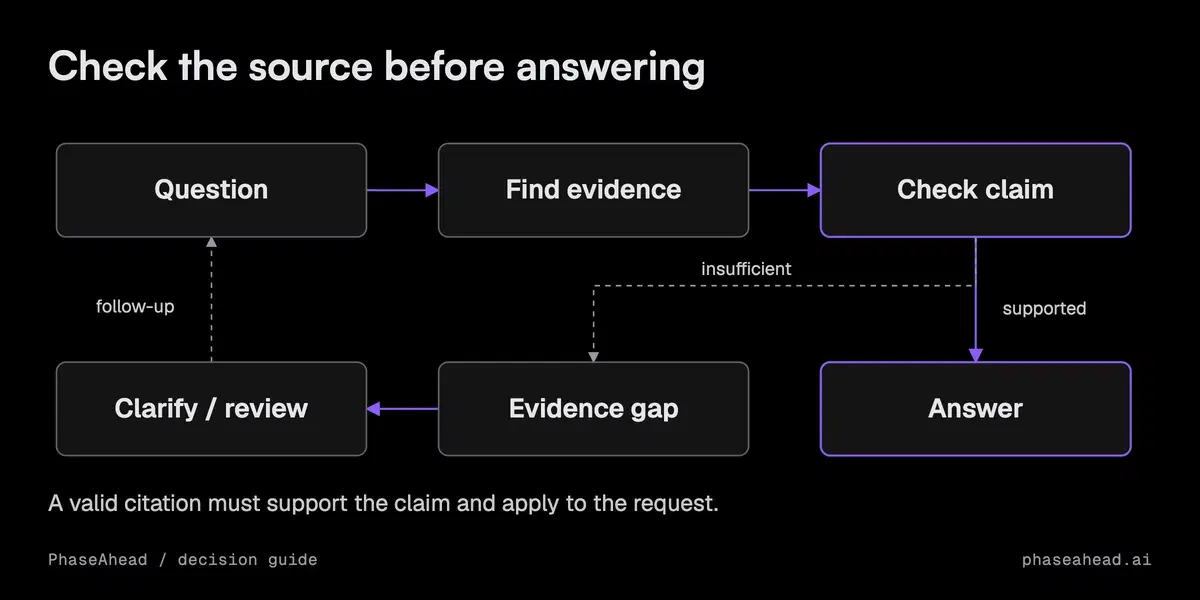
Retrieval is not always necessary. A small, current set of authorized documents may fit directly in the prompt. A structured database query may be more reliable for a precise account fact. Choose the source path using the task and access requirements.
Separate a suggestion from permission to act
A model may draft a refund response. Code should still enforce eligibility, account ownership, and refund limits before money moves.
Treat retrieved text as evidence, not instructions to change the application's rules. A document saying "ignore the approval requirement" must not bypass a permission check.
Use structured fields when they make an answer easier to validate. A schema can enforce the presence of an order ID and an outcome field. It cannot prove the ID belongs to the customer or the outcome is correct. Those checks need trusted data and application logic.
Give uncertain requests a useful destination
| Situation | Product behavior |
|---|---|
| A required detail is missing | Ask a specific follow-up question |
| The relevant policy cannot be found | Say what could not be verified |
| Two applicable sources disagree | Send the conflict for review |
| The answer would authorize a consequential action | Apply the separate approval policy |
| Evidence supports a permitted answer | Respond with the relevant source |
Avoid adding a confidence threshold just because the API returns a number. Validate that signal on labeled requests from your domain. Count wrong answers that pass the check and answerable questions that are needlessly sent to a person.
A review queue also needs an owner. Preserve the question, evidence, and reason for escalation, with appropriate access and retention controls. Otherwise the system merely transfers an unresolved problem to another screen.
Measure incorrect answers and missed opportunities
Create evaluations that cover ordinary questions, ambiguous requests, exceptions, and unavailable evidence. Check whether the evidence supports each claim that could affect the customer's decision. Also measure whether the feature declines questions it should answer.
Evaluation best practices emphasize task-specific checks and continued evaluation. Review automated scoring against human judgments, especially when the model is grading subtle factual claims.
After launch, connect corrections and complaints to the recorded request, sources, and answer. Track repeated failure categories and feed them back into source maintenance, retrieval, prompts, and model evaluation. Changing all of those at once makes it harder to identify what helped.
Take one recent wrong answer into the next review. Find the first point where the system lacked evidence or ignored it, then add a check at that point. That is a more useful starting task than a general instruction to "make the AI more accurate."

Sources
- OpenAI: Why language models hallucinate
- Stanford HAI: Benchmarking legal AI tools
- OpenAI: Evaluation best practices
Common questions
Does RAG eliminate hallucinations?
Does RAG eliminate hallucinations?
No. Retrieval can supply relevant evidence, but the system can retrieve the wrong material, miss a qualification, or make an unsupported claim. Evaluate retrieval and the resulting answer separately.
Can we use the model's confidence to approve answers?
Can we use the model's confidence to approve answers?
Do not treat a verbal confidence score as an error probability without validation. Evaluate the signal against labeled examples from your task before using a cutoff.
When should the feature ask a person?
When should the feature ask a person?
When required evidence is missing, sources conflict, or the potential consequence exceeds the authority granted to the feature. Assign an owner and preserve the information needed to resolve the request.
Does a citation prove an answer is correct?
Does a citation prove an answer is correct?
No. The source must exist, be accessible to the user, support the claim, and apply to the request. A valid link alone proves none of those things.