AI automation agency vs in-house team
Choose an automation partner or an internal team by the work ahead, ownership, hiring capacity, and maintenance needs. Compare the full cost of each route.
On this page
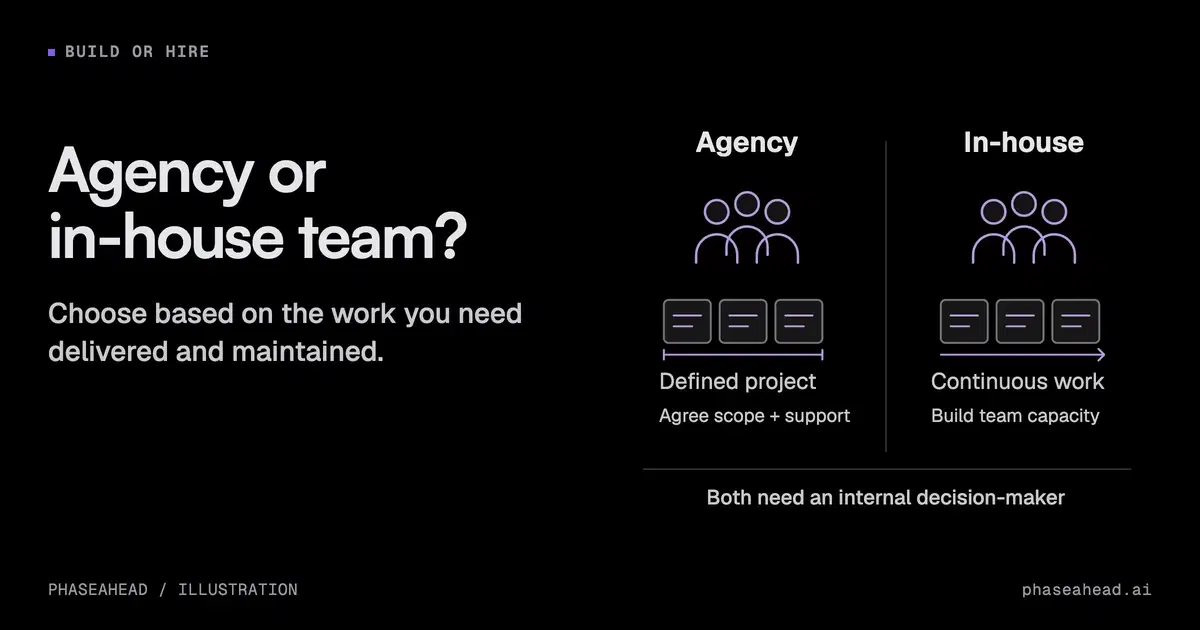
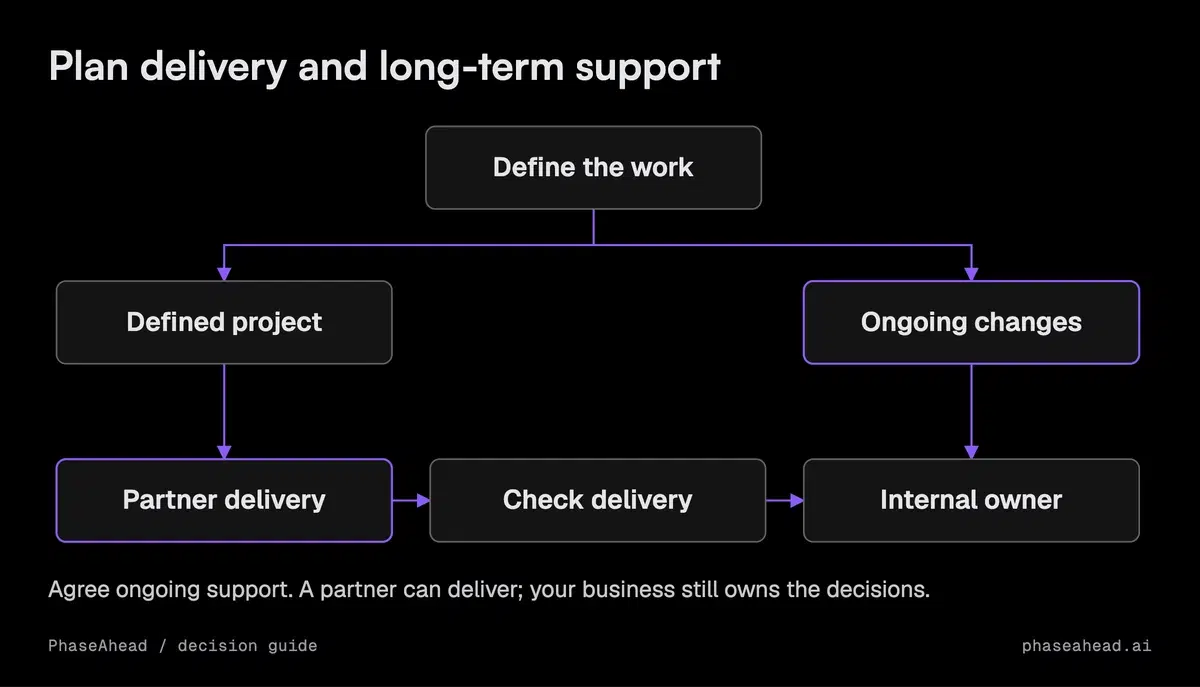
If automation is a continuous part of your product, build internal ownership. If a clearly defined workflow is waiting on skills or capacity you do not have, a partner can help deliver it. Neither choice removes the need for someone inside your business to own the outcome.
The useful comparison is the work you expect over time. A one-time integration and a changing AI product need different staffing decisions, even when both use the same tools.
TL;DR Consider a partner for a defined project your team cannot deliver yet. Build an internal team when ongoing work and management capacity can support one. Either route needs someone inside the business to approve results and own the decisions.
Start with the work after launch
List the changes you expect: new business rules, vendor API updates, access reviews, failure handling, and additional workflows. Name who will approve those changes and who will respond when the automation stops.
A delivery partner can build a workflow, but cannot decide your refund policy or reconcile conflicting instructions from two departments. Name the person who can make those decisions before hiring either an agency or an engineer.
| Your situation | Route worth considering | Condition to check |
|---|---|---|
| Defined project, not enough skills or time | External partner | Clear acceptance criteria and handover |
| Continuous product development | Internal team | Enough work and management capacity |
| Urgent project with an internal team forming | Partner with planned transfer | Receiving team participates early |
| Routine workflow already supported by a product | Buy and configure | Integration, access, and export fit |
Compare full costs over the same period
For hiring, include compensation, employer costs, recruiting, equipment, onboarding, and the time needed to manage the role. The SBA's employee-cost guidance is a useful reminder that salary alone is incomplete. Use figures for your location and role, not a US salary benchmark applied to every team.
For a partner, include discovery, implementation, change requests, subscriptions, support, and the internal time spent reviewing the work. Check what happens when an integration changes after acceptance.
A lower initial quote may exclude ongoing ownership. A higher payroll cost may buy capacity that several projects will use. Compare the work included, support hours, and response times before comparing totals.
Ask for evidence of the work you need
A polished demo does not show whether a supplier can deliver your integration. Ask for similar work the supplier can show it delivered, and what that work involved. Do not infer experience from a list of tools or assume every agency has reusable systems for your problem.
Discuss a failure scenario during selection. If the customer system accepts an update and then the connection drops, how will the integration determine whether to retry? The answer reveals more than a generic promise of reliability.
For model-driven work, ask how the team measures correct outcomes. Anthropic's agent guidance supports starting with simpler workflows where possible. A supplier should be able to explain when your workflow needs a model and when ordinary code is enough.
Put ownership into the contract and delivery
Agree where the code and workflows live, who owns the accounts, and how credentials are managed. Record any license or platform dependency that limits transfer.
Acceptance should include a working deployment, representative evaluations, monitoring, and recovery instructions. OpenAI's evaluation guidance is relevant when success depends on model behavior; a conventional integration also needs functional checks around its business rules.
Have the receiving team test the handover. Someone should make a small change, deploy it, and recover a failed run using the delivered instructions. A document saying those actions are possible is weaker evidence than doing them.
Make the next step small enough to judge
If the choice is still unclear, scope one workflow with a defined outcome and a named owner. Compare an internal delivery plan and a partner proposal against the same acceptance criteria.
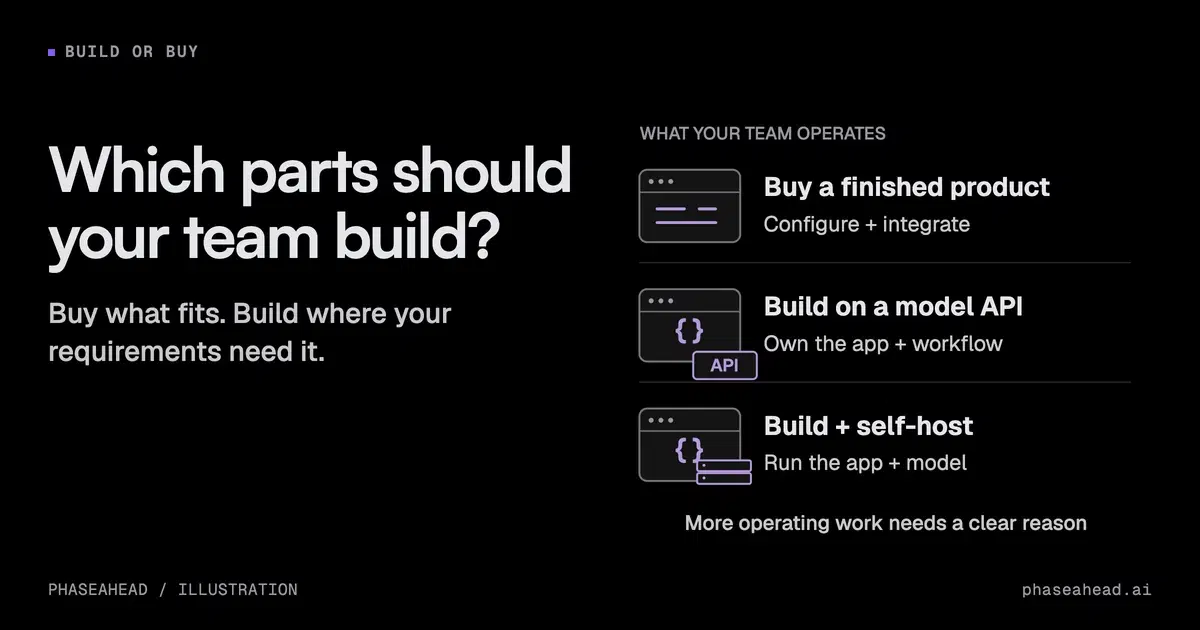
Keep that staffing question separate from whether to build or buy the software. An internal team can configure a managed product, and a partner can build code you own. For either route, include the ongoing AI operating cost before approving the project.

Sources
- U.S. Small Business Administration: How much does an employee cost you?
- Anthropic: Building effective agents
- OpenAI: Evaluation best practices
Common questions
When does an automation agency make sense?
When does an automation agency make sense?
When the project has a clear scope, your team lacks the skills or time to deliver it, and someone inside the business can approve the result. Check the partner's relevant evidence and handover terms.
When should we hire internally?
When should we hire internally?
When the work is continuous, closely tied to your product, and substantial enough to justify a lasting team. Include recruiting, management, and operational ownership in the decision.
What should we own after an agency engagement?
What should we own after an agency engagement?
Agree ownership and access in the contract. Typically you need your accounts, source or workflow exports, credentials, deployment instructions, tests, and an explicit support arrangement.
Can an agency build the first version and our team maintain it?
Can an agency build the first version and our team maintain it?
Yes, if that handover is part of the scope from the start. Have the receiving team deploy, diagnose a failure, and make a change before acceptance.