When to replace an LLM classifier with Jev
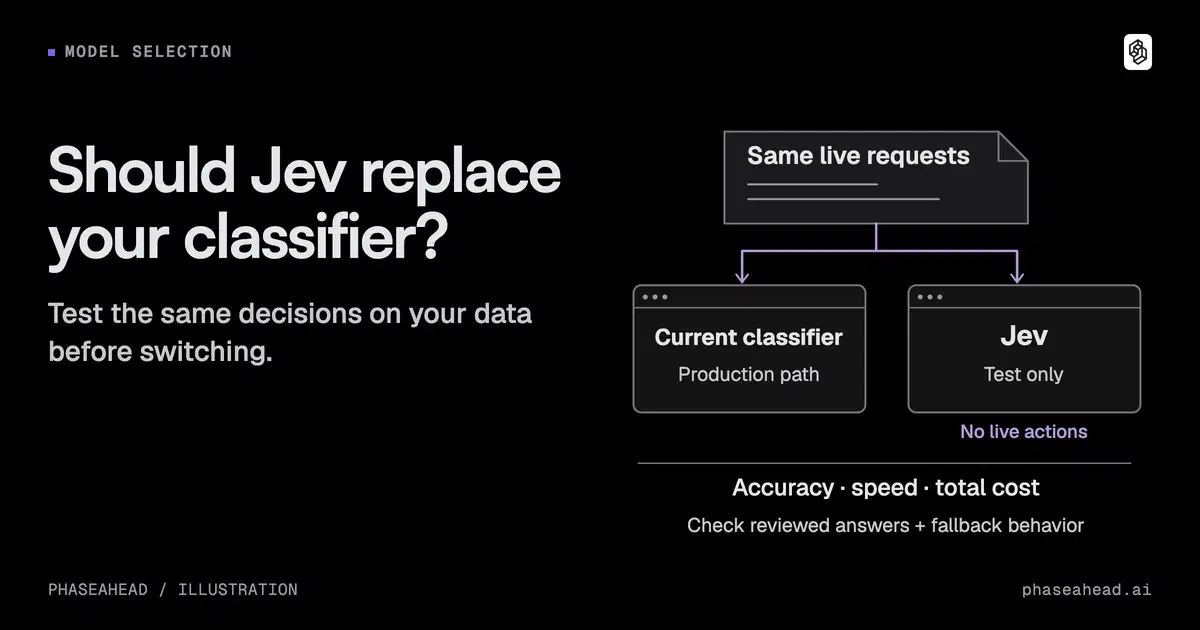
Compare Jev with your current text classifier on accuracy, speed, total cost, and how uncertain requests are handled before deciding to switch.
On this page
If an LLM spends time and money sorting support tickets or checking a yes-or-no question, Jev is worth evaluating. Replace the existing classifier only if the candidate meets your quality requirements and improves the complete workflow enough to justify migration.
The useful question is specific: can this model make this decision, on your data, quickly enough and with an acceptable error rate? A vendor's maximum speed or cost advantage cannot answer it.
TL;DR Test Jev on a classification task that is already too slow or expensive. Compare accuracy, response time, and total cost, including fallback. Keep the current system unless the improvement justifies switching.
What the product changes
TypeSafe's System One documentation describes models designed to return decisions rather than write replies. Choice selects from options you define. Score rates text against levels you define. Noul returns a probability for a true-or-false statement.
That can fit ticket routing or checking which requests need further review. It does not replace a model that needs to draft a response, write code, or explain a result.
A predictable response format makes the result easier for your software to use. It does not prove the selected answer is right. You still need suitable definitions, relevant input, and evaluations against reviewed outcomes.
Separate probability from confidence
TypeSafe describes training for calibrated decisions. Calibration concerns groups of predictions: whether assigned probabilities match observed outcomes across comparable cases. It is not a guarantee for one answer or a promise that calibration transfers unchanged to your domain.
There is also an API distinction. The confidence documentation says the Choice and Score confidence field is derived from the answer's probability distribution. Noul does not carry that additional field. Treating a confidence value as a probability of correctness skips an important check.
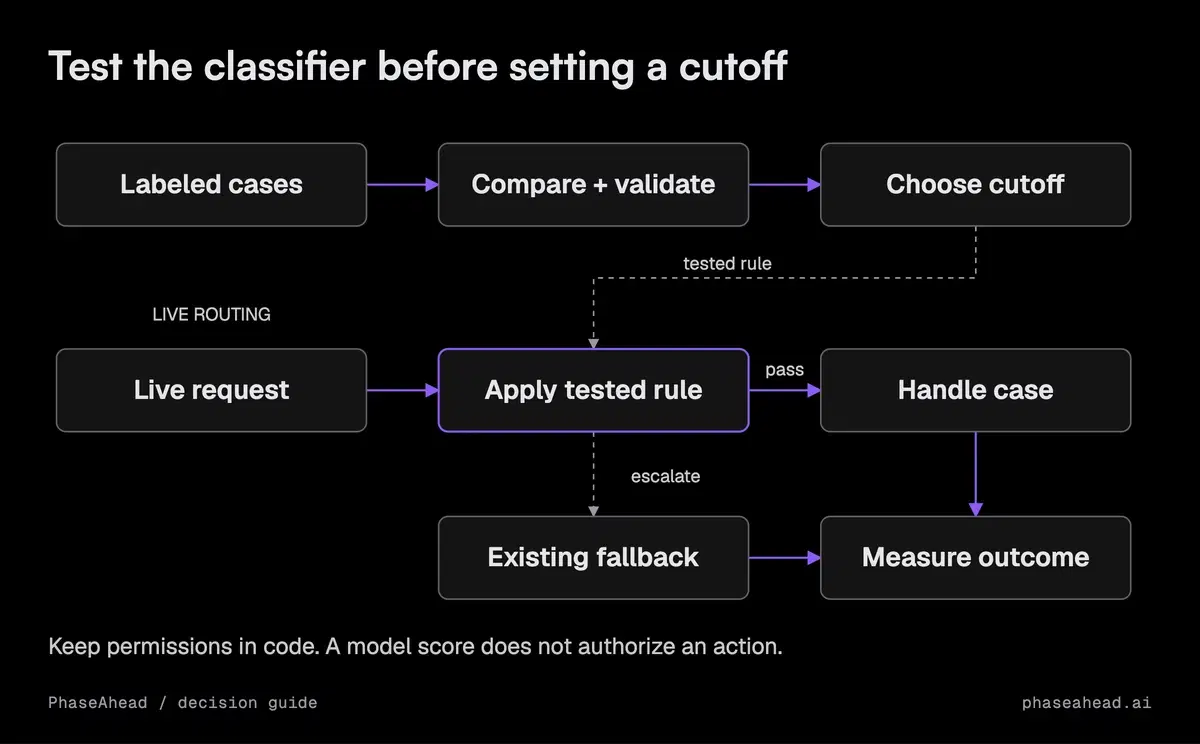
Choose your cutoff using examples with reviewed answers, then test it on a separate set that did not influence that choice. Measure false approvals, missed cases, and the volume sent to review. A cutoff that works on the examples used to choose it may still fail on new requests.
Compare with the system you would actually run
Include your current classifier and a reasonable alternative. If the current system uses an expensive general model, a smaller model or a conventional classifier may also solve the problem.
Compare end-to-end latency, including network time, retries, and any follow-up call. For cost, count the candidate on every request plus the fallback on escalated requests. Add human review where the new design creates it.
A cheap first stage that escalates most traffic may add latency and cost. A classifier that resolves a useful share correctly may earn its place even without winning every benchmark. Use cost per completed task to judge the result.
Keep authority outside the model
A classifier can flag suspicious input or recommend a route. It should not grant access to another customer's account or bypass a required approval.
Enforce permissions at the action boundary. Uncertain or unsupported judgments need a defined fallback. The model documentation also describes capability and language considerations that belong in your evaluation.
If the decision is consequential, examine errors by category rather than accepting one aggregate accuracy figure. A wrong support label and an incorrectly approved financial action have different costs.
Run a trial that tells you whether to switch
- Define the decision and the errors that matter. Review ambiguous labels before comparing models.
- Run the candidate without side effects while the current production system remains authoritative.
- Compare both against reviewed labels. Investigate disagreements rather than assuming the old classifier is always correct.
- Choose thresholds on one set of data and evaluate them on held-out cases.
- Test outages, rate limits, malformed responses, and the cost of fallback.
- Decide whether the measured gain justifies maintaining another dependency.
Set the amount of testing according to the risk of a wrong decision. Include enough examples of important errors to judge whether the new system meets your requirements.
Keep the current path available during a restricted rollout. Watch for changes in input mix and review rates, using the same quality-monitoring process as other AI features.
Start with the classifier that already creates a visible bottleneck. If no such bottleneck exists, the most useful outcome of the evaluation may be to keep the current system.

Sources
- TypeSafe: System One concepts
- TypeSafe: Confidence
- TypeSafe: Models
- TypeSafe: Confidence routing
Common questions
Should we replace our LLM classifier with Jev?
Should we replace our LLM classifier with Jev?
Test it when a clearly defined decision is too slow or expensive. Compare it with your current system and a suitable small-model or conventional classifier baseline before migrating.
Is Jev confidence the probability that the answer is correct?
Is Jev confidence the probability that the answer is correct?
Not directly. TypeSafe documents confidence as a statistic derived from the distribution for Choice and Score. Validate probability and confidence signals on your task before using thresholds.
Can Jev enforce a security boundary?
Can Jev enforce a security boundary?
A model judgment should not authorize access or replace deterministic controls. Keep permissions and hard denials in application code, regardless of the classifier score.
How should we run a shadow trial?
How should we run a shadow trial?
Keep the existing production decision authoritative. Run the candidate without side effects on permitted data, compare outputs with reviewed labels, and test its failure and fallback paths.