OpenAI DevDay: what changes for your business?
OpenAI DevDay added a hosted browser, a Sol upgrade, and new work tools. Decide when to use Dots, build on Agents API, or keep your existing setup.
On this page
OpenAI's September 29 DevDay updates included a GPT-6.1 Sol upgrade and an OpenAI-hosted browser for the existing Agents API. Dots offer ongoing work inside supported apps, and Codex Security Cloud adds another option for reviewing connected code projects.
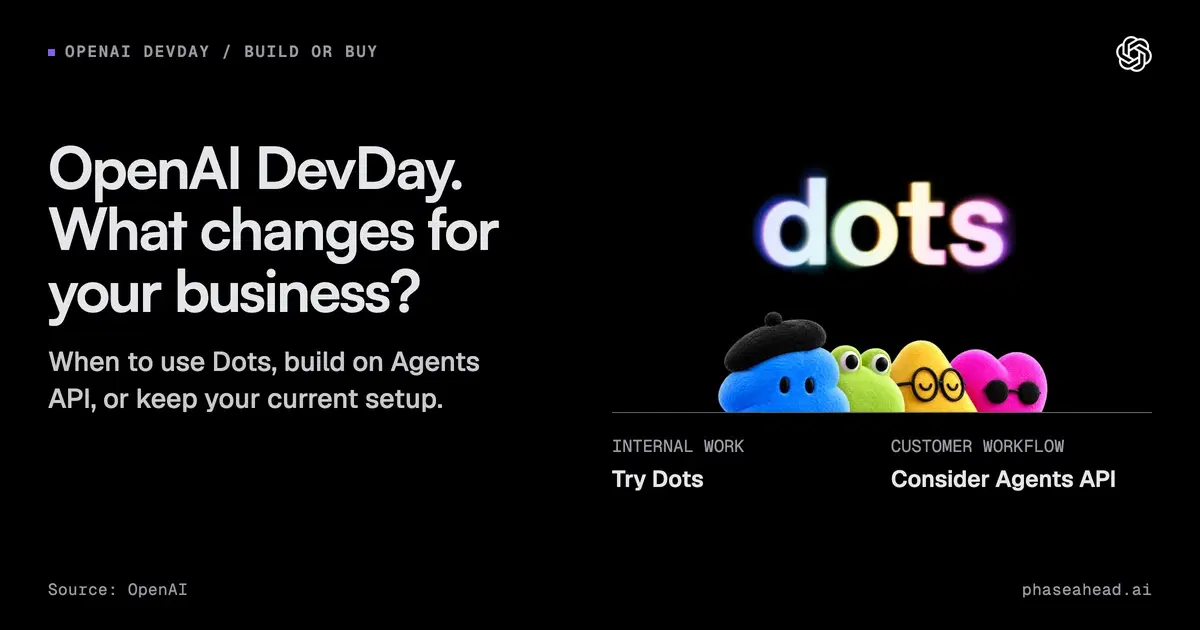
For a product team, these tools can change which parts are worth building. Try Dots for internal work your staff can do through its supported apps. Build on an API when customers need your workflow and account rules. Keep your current implementation when the new service cannot meet a requirement you already depend on.
The API changelog dates the browser addition and Sol release to September 29. The Agents API itself entered public beta on September 10. The new browser makes that existing service relevant to more website tasks.
TL;DR Try Dots for internal work when its apps, permissions, and availability fit. Consider the Agents API browser when you need a custom product experience but do not want to run the browser infrastructure. Keep ownership of the workflow, access rules, and customer support. Check data requirements before committing: the Agents API currently supports US data residency only and does not support Zero Data Retention.
Use Dots when the work belongs to your team
Dots can continue assigned work between conversations, use connected apps, and work with a computer and browser on OpenAI's servers. You can inspect the work and take over a browser step.
Suppose an operations employee tracks venue deadlines and prepares replies. If a dot can use the required documents and apps, that employee may not need a bespoke application just to prepare the drafts. The employee still owns the deadlines and reviews replies before sending when the task requires it.
The fit changes when you need to offer that service to your customers. Customer onboarding, access to each account's data, a particular approval screen, and support for unfinished work are product requirements. A work assistant does not automatically supply those requirements in your application's interface.
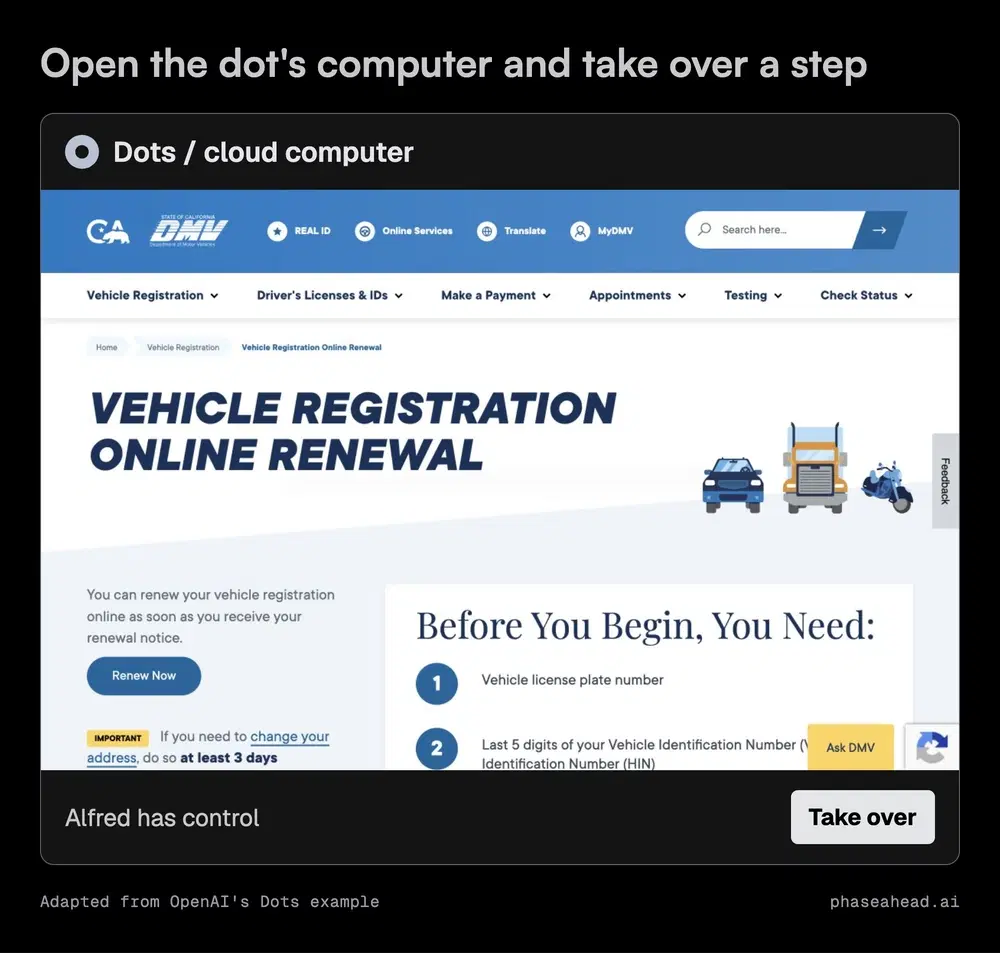
Check availability before treating it as a team-wide option. OpenAI describes a gradual rollout, with plan and regional restrictions. Enterprise access needs a workspace administrator to enable it. Dots also apply app permissions and approval checks; assigning a task does not grant unrestricted access.
Consider the Agents API for a custom workflow
The Agents API lets OpenAI run the agent through a task and save its progress. The September 29 browser addition lets the agent work on websites in an OpenAI-hosted environment with desktop access enabled.
For a business building software around a supplier portal, that could remove the need to provision and operate the browser computer. Your application would still collect the task, handle website access and sign-in requests, follow progress, and present the outcome to the user.
Consider a customer who wants an invoice downloaded from a supplier portal. Your product needs to know which customer's account to use, which invoice was requested, where the file may be stored, and what happens if sign-in fails. Those requirements remain even when OpenAI runs the browser.
If a supplier offers a suitable API, evaluate that route too. A direct integration may avoid browser steps. Use the browser where the website task is actually needed, rather than adding it to a workflow that already has a dependable integration.
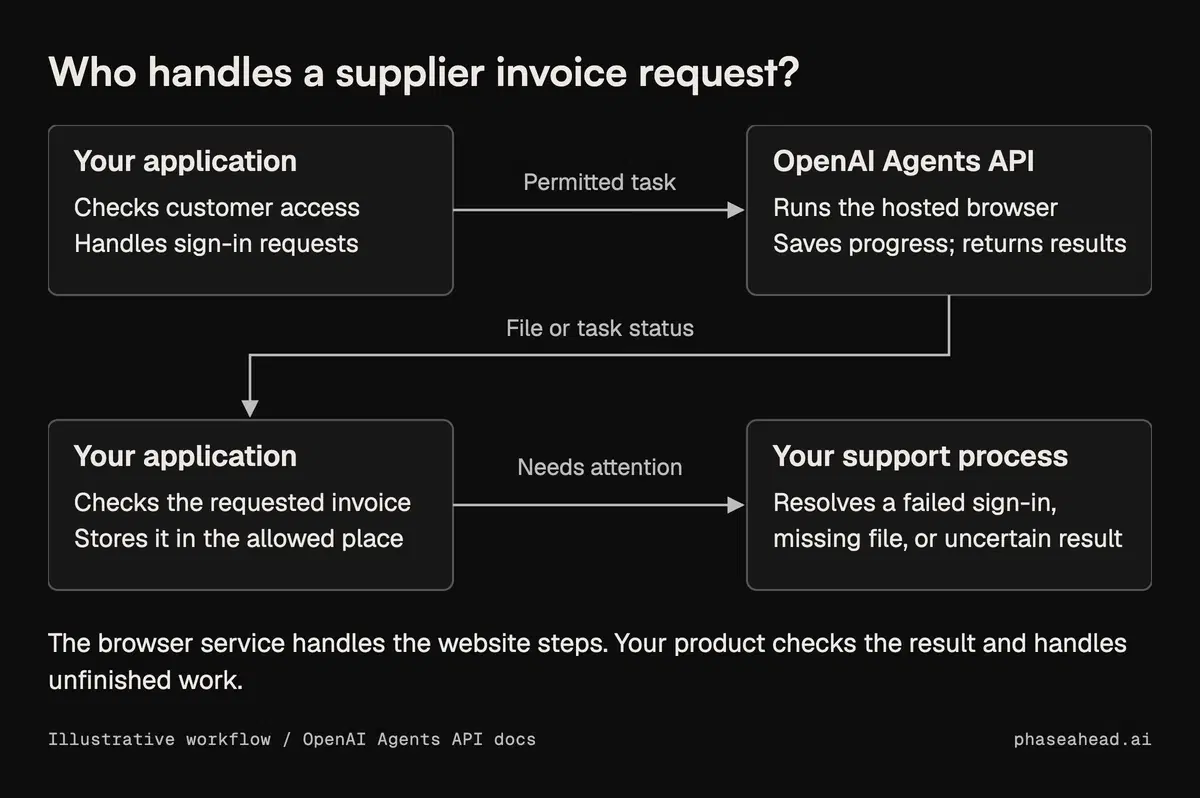
Managed execution can reduce infrastructure work. It does not establish that the task completed correctly. Before replacing your existing implementation, identify which component you would retire and which application behavior must remain.
Check the data requirements before choosing the service
As checked on October 1, the Agents API overview says data residency is supported only in the United States and the service does not support Zero Data Retention, OpenAI's option for avoiding storage of eligible API request and response content. Choosing a self-hosted sandbox does not make the Agents API eligible for it.
If a customer contract requires processing in another supported region or requires Zero Data Retention, resolve that requirement before planning a migration to this service. Do not assume that moving the tool's computer moves all processing or stored session data.
These are Agents API constraints. Check Dots and other OpenAI products under their own documentation and terms rather than applying one product's conditions to all of them.
For a team that needs to control where the agent process runs, OpenAI's runtime comparison lists the Agents SDK as an option that runs inside your application. That is a different integration choice. It does not by itself settle where model requests are processed or stored.
Treat Sol and Security Cloud as separate decisions
GPT-6.1 Sol is a model upgrade, not a reason by itself to rebuild an application. It arrived at the same standard input and output rates as GPT-6 Sol, with a lower rate for saved input the service can reuse. The model guide describes capability and integration changes.
For a team already using GPT-6 Sol, review the migration guidance and compare the upgrade on the work the product performs. For a team using another model, a vendor benchmark alone is not enough reason to move a working feature. The monthly cost forecast should account for model use, tools, hosted computers, and the work required to handle incomplete tasks.
Codex Security Cloud is in research preview and scans connected GitHub projects. It can investigate suspected vulnerabilities and suggest a patch. OpenAI says to review proposed patches before creating a pull request.
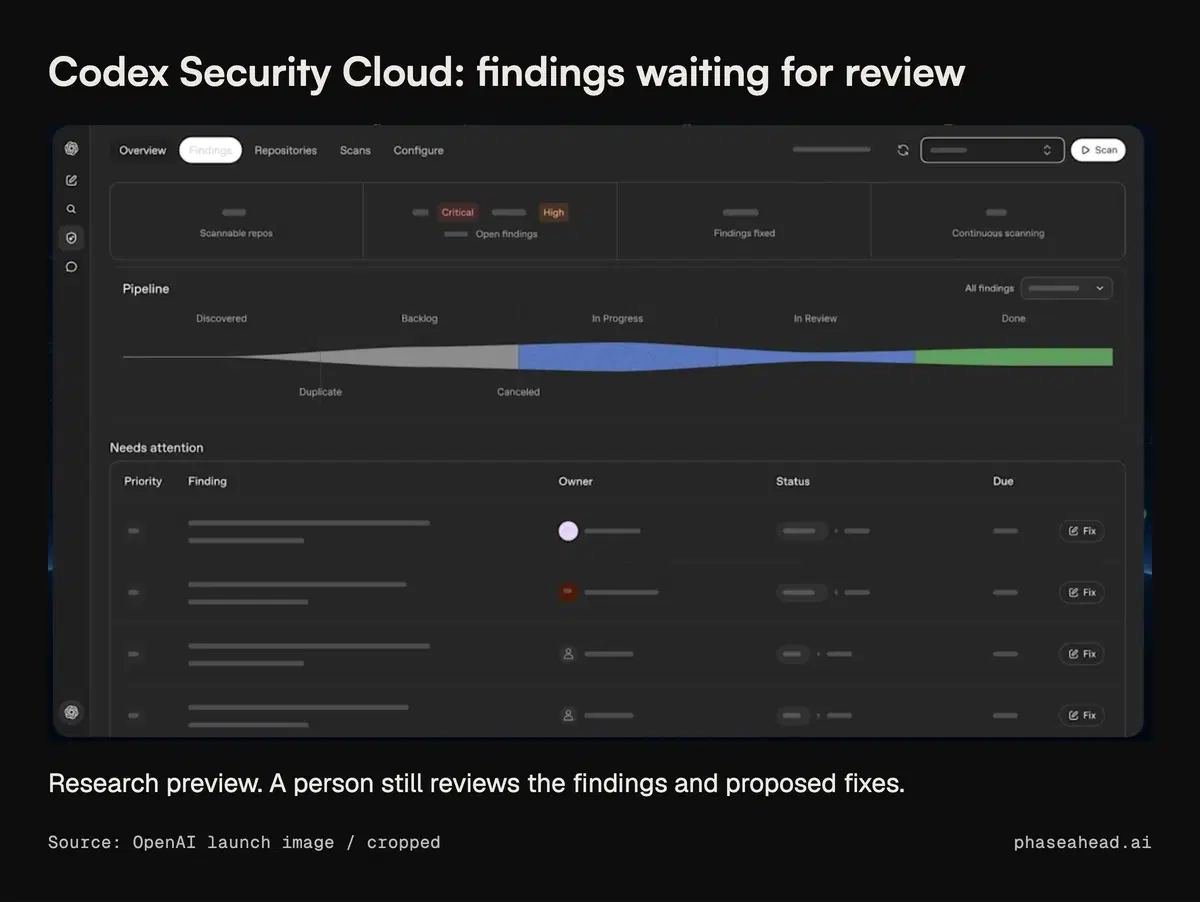
A team with a review backlog could assess whether it helps find and explain issues in its repositories. Keep the person who decides whether a finding is valid and whether a fix is ready. A scan is not a substitute for the product's access controls or release review.
Change the part of the roadmap the launch actually affects
Take the work item you were planning to build and separate the employee's job from the customer's product experience.
If it is an internal task that fits Dots, try the available product before commissioning a separate interface. If it is a customer-facing workflow and the Agents API meets your data requirements, compare its managed browser with the browser component you planned to operate. If you already have a reliable integration, retain it until a specific requirement or operating burden justifies replacing it.
The useful output is a revised scope: which service you will use, which component it replaces, and who owns the customer outcome. The broader build-or-buy decision still depends on those requirements.
Sources
- OpenAI Developers: API changelog
- OpenAI Docs: Meet dots
- OpenAI Developers: Agents API overview and data constraints
- OpenAI Developers: Agents API computer use
- OpenAI Developers: Agent runtime comparison
- OpenAI Developers: GPT-6 model guide
- OpenAI Docs: Codex Security Cloud
Common questions
Should we use Dots or build an agent into our product?
Should we use Dots or build an agent into our product?
Try Dots when the job belongs to an employee working in supported apps and the available permissions fit. Build an application when customers need your interface, account rules, integrations, and support process. These choices can coexist.
Does the Agents API browser run on our own computer?
Does the Agents API browser run on our own computer?
The documented browser feature requires an OpenAI-hosted environment with desktop access enabled. Other Agents API tasks can use different environment options, but that does not make this browser feature available on every environment.
Can we use Agents API with Zero Data Retention?
Can we use Agents API with Zero Data Retention?
As checked on October 1, 2026, the Agents API overview says it does not support Zero Data Retention and supports data residency only in the United States. A self-hosted sandbox does not change its Zero Data Retention eligibility.