Gemini 4 Argon: should your team switch?
Gemini 4 Argon is in limited rollout. See who can access it, what Google has announced about pricing, and when your product team should test a switch.
On this page
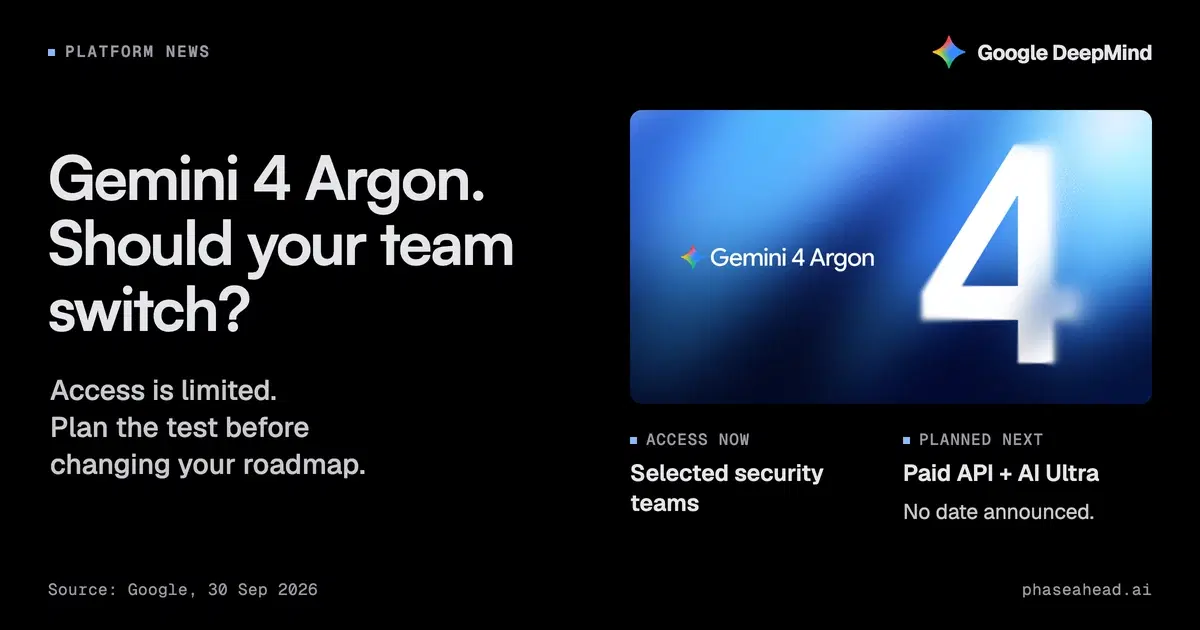
Google announced Gemini 4 Argon on September 30, 2026. Most product teams cannot switch to it yet. Access is rolling out to selected cybersecurity teams in Google's Fairwind Program. Google plans to expand access to developers, enterprises, and consumers, starting with paid API customers and Google AI Ultra subscribers. It has not announced a date for that wider release.
If your product already uses an AI model, we'd keep it in place and collect real tasks where it fails or costs too much. If you are planning a new feature, choose a model you can use today. Revisit Argon when your account has access and you can test its quality, speed, and cost.
TL;DR Most product teams should keep shipping on an available model. Argon's larger output allowance could help with long coding or research tasks, but access is limited and wider API terms are not yet documented. Prepare examples of work your current system handles poorly. When access opens, switch a task only if Argon improves the result within your quality, time, cost, and security requirements.
What did Google announce for Gemini 4 Argon?
The announcement describes Argon as a model for software engineering, financial and legal research, and cybersecurity defense. Google has raised its output limit from 64,000 to one million tokens. A token is a small unit of text, such as a word or part of a word. Output is what the model generates; input is the material it reads. The announcement does not state Argon's input limit.
Google reports 51.3% on AutomationBench, a test of completing business tasks. That score describes performance on the benchmark. It does not establish how often your product's tasks will finish correctly or how much review they will need.
Fairwind is a controlled defense program. Its terms limit access at approved partners to internal cybersecurity, incident response, or security testing teams, and forbid sharing or reselling model access. The program's FAQ says Argon supports zero data retention through direct managed access on Gemini Enterprise. This means not retaining submitted data, subject to Google's platform configuration and feature conditions. That statement does not establish the data terms of a future Gemini API release or the AI Ultra subscription.
Does Argon change your product roadmap?
Start with access and the problem you need a different model to solve. Google's reported results make long coding and research tasks worth comparing once you have access.
| Your situation | Decision now | What would change it |
|---|---|---|
| An AI feature already serves customers | Record failed or expensive tasks. | Argon is available and improves those tasks within your requirements. |
| A new product needs a model this month | Build with an available model your team can replace later. | Argon access and suitable terms arrive before your release decision. |
| Your team handles large coding or document tasks | Save examples and record the time spent correcting them. | Argon reduces corrections at an acceptable cost and speed. |
| Your team works in cybersecurity defense | Check eligibility and permitted uses with Fairwind. | Google approves access and testing shows a fit for your permitted work. |
For a customer-facing product, a stronger model can improve one component without supplying the rest of the service. Your application still needs to know whose data it may use, which action the user approved, when a result needs review, and what happens after an incomplete run. The build-or-buy decision remains about the whole product, not only the model behind one step.
What will Argon cost to run?
Google's announced API rates are:
| Per million tokens | Introductory rate | After the introductory period |
|---|---|---|
| Input | $2 | $4 |
| Output | $10 | $20 |
The launch pricing also includes a 95% discount for cached input, material saved for reuse by later requests. Google has not stated when the introductory period ends or published full billing conditions. The public Gemini API model list and pricing page did not list Argon when checked on October 1. Confirm the rates and terms that apply when your account gets access.
Budget for the work needed to get a usable result. Include every model request, any tool charges, retries, and the time a person spends checking or fixing the output. Cache discounts help only when your requests qualify and reuse saved material. The monthly cost guide explains how to include these costs in a product budget.
The one-million-token ceiling is a maximum amount of generated output, not a target length or a promise that a whole job will finish in one request. If your product needs a short, fast reply, a larger ceiling alone gives you no reason to switch.
What should you test when access opens?
Choose a task your current system handles badly or expensively. Use real examples your team is allowed to process, such as a code change or research across several documents. Then compare the models under the same conditions:
- Keep the request, tools, and source material as similar as possible. Set rules for accepting a result before looking at Argon's output.
- Record whether the result passes those rules, what a reviewer corrects, how long the work takes, and the total model and tool charges. Include repeated attempts and review time.
- Include difficult cases: conflicting documents, outdated data, and actions the user is not allowed to take. Also test instructions hidden in a document that try to redirect the model. This is prompt injection. Google's reported improvements against these attacks do not replace the access checks your application must enforce.
- Check the conditions your product needs: availability in your region, data handling, request limits, supported tools, and how Google versions the model. Confirm that your team can restore the previous model if results get worse.
Use your product's existing quality, speed, cost, and security requirements to judge the comparison. A higher benchmark score does not justify a switch if the model needs more corrections or misses the response time customers expect. The production-readiness guide covers the surrounding checks a model change still needs.
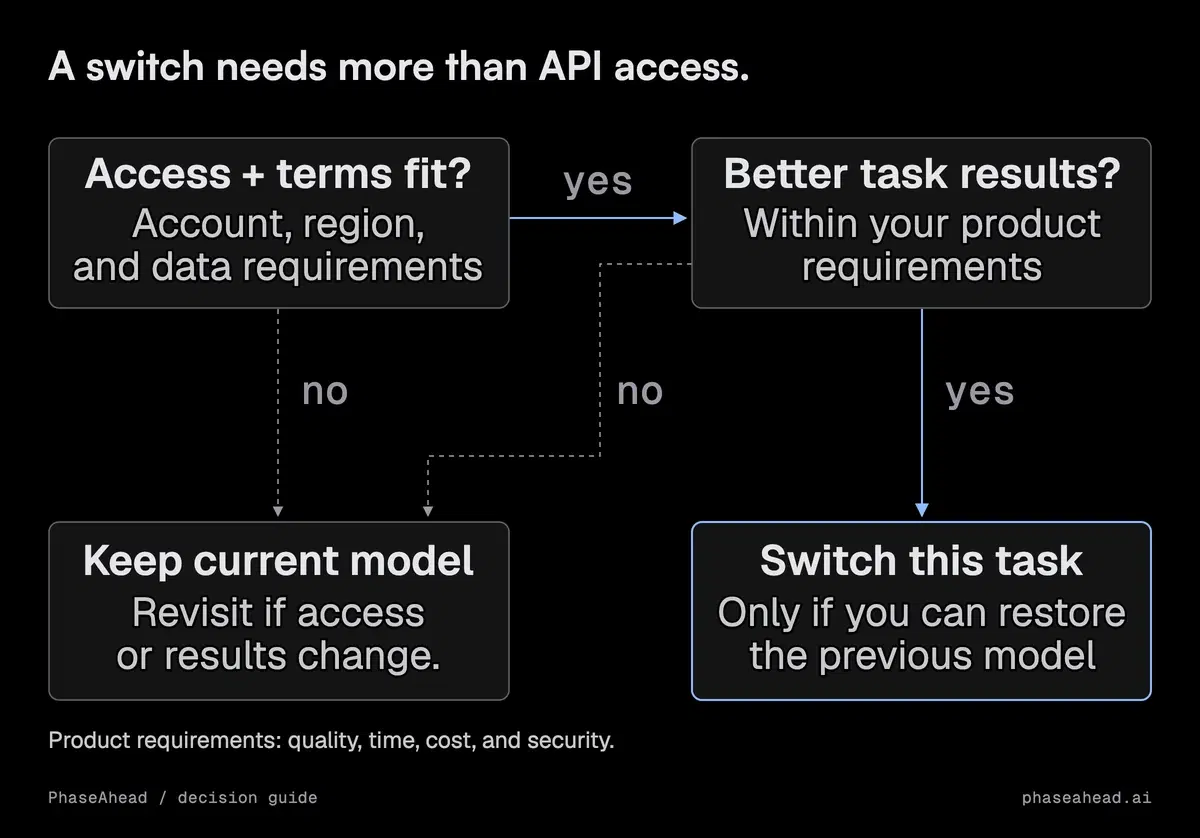
Pick one costly or unreliable task to compare first. If Argon improves that task and meets your requirements, move it with a way to switch back. Keep the rest of the product's model choices tied to their own results.
Sources
- Google: Gemini 4 Argon announcement
- Google DeepMind: Fairwind Program access and terms
- Google Cloud: Zero data retention conditions
- Google AI for Developers: Gemini API model list
- Google AI for Developers: Gemini API pricing
Common questions
Can a product team use Gemini 4 Argon through the Gemini API today?
Can a product team use Gemini 4 Argon through the Gemini API today?
Google says Argon is currently rolling out to selected cybersecurity teams through Fairwind. It plans broader access, starting with paid API customers and Google AI Ultra subscribers, but has not given a date. Confirm that your account can use the model before planning an integration.
What will Gemini 4 Argon cost?
What will Gemini 4 Argon cost?
Google announced introductory pricing of $2 per million input tokens and $10 per million output tokens, with a 95% discount on cached input, material saved for reuse by later requests. Its announcement says prices will become $4 and $20 after the introductory period, but does not give that period's end date. Confirm the rates and billing terms when your account gets access.