How to calculate AI voice agent cost per minute
Calculate voice-agent cost from the configured platform, audio, model, and phone-service charges. Include transfers, fixed fees, and successful call outcomes.
On this page
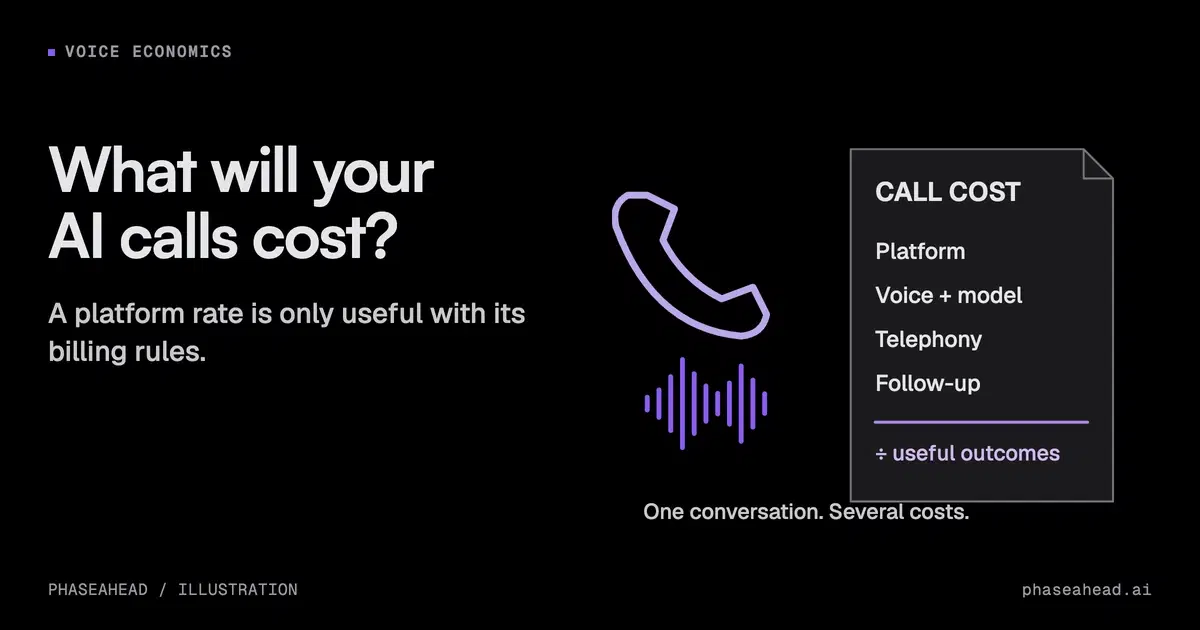
An AI voice agent has no single reliable all-in price per minute. The cost depends on the selected platform, model, voice, phone service, and billing rules. Phone-service charges, often called telephony, cover the number, call route, and call minutes. Some products bundle those costs; others charge them separately.
Estimate the setup you plan to use, then compare that estimate with the charges from trial calls. For a business decision, also calculate cost per successful outcome. A low rate is less useful if the agent takes longer, transfers unnecessarily, or fails to complete the booking.
TL;DR The advertised rate may cover only part of a call. Add the charges for your chosen setup without double-counting bundles, then track cost per connected minute and per successful outcome.
Identify what the headline includes
As checked on October 1, 2026, Vapi's public calculator shows a $50 hosting fee for 1,000 minutes, with model and other provider costs listed separately. That hosting fee is one part of the bill.
Retell's pricing page advertises $0.07 to $0.31 per minute for AI voice agents. Its calculator separates model, voice infrastructure, text-to-speech, telephony, and add-on costs. The same page lists some speech-to-speech models above the advertised range, so do not treat $0.31 as a ceiling for every configuration.
ElevenLabs Agents sells plans with included call minutes. Its pricing FAQ says language-model usage is billed separately and an external phone provider, such as Twilio, bills its own charges directly. Included minutes therefore do not necessarily cover the whole call cost.
Save the configuration and quote date. A rate without its assumptions is difficult to compare or audit later.
Keep each service in its billing unit
A voice system may use separate services to transcribe speech, generate a reply, and read it aloud. A realtime audio model can combine parts of that work. Do not add separate speech charges to a bundle that already includes them.
| Charge | What to record |
|---|---|
| Platform | Connected time, rounding, included usage, minimum spend |
| Speech or realtime audio | Audio duration or tokens under that service's rules |
| Language model | Actual billed input, output, and caching categories |
| Telephony | Country, direction, number type, duration, and transfer legs |
| Extras | Phone numbers, recording, storage, support, and selected add-ons |
| Human work | Review, transferred calls, and corrections |
Twilio's voice pricing illustrates why telephony needs its own assumptions. The relevant price depends on the call route and service, not just whether a call exists.
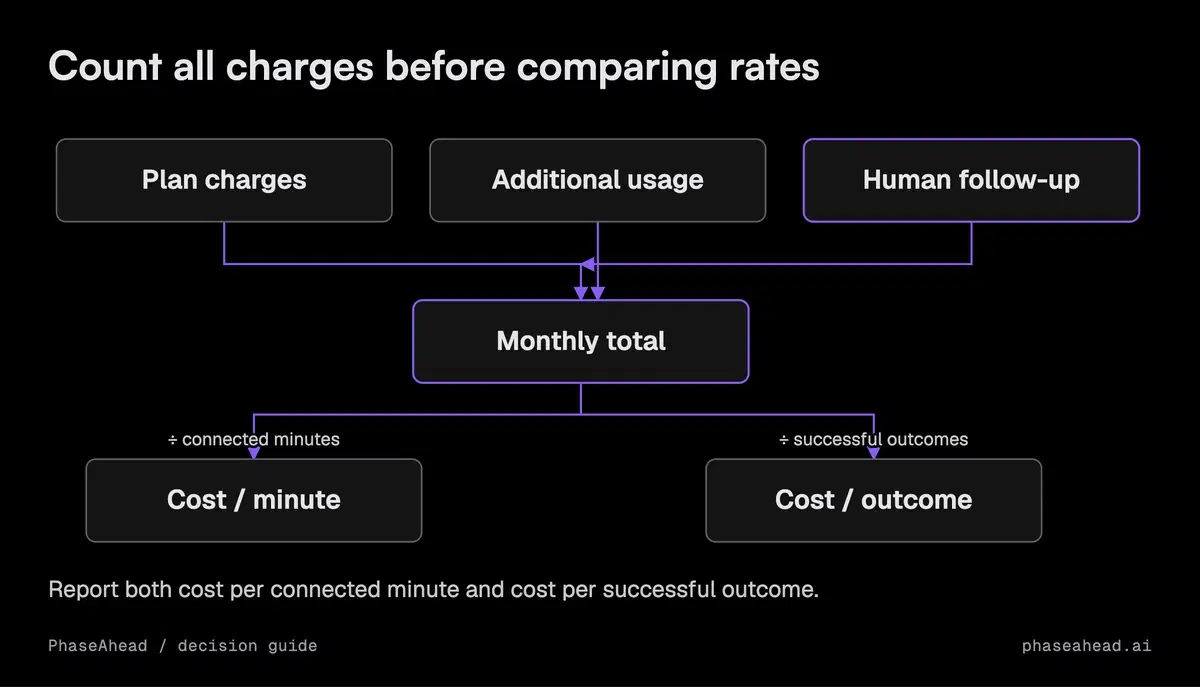
Calculate the month before reducing it to a minute
Monthly voice operating cost =
  platform charges + additional provider usage + telephony
  + fixed fees + review and follow-up

Blended cost per connected minute =
  monthly voice operating cost / connected minutes

Cost per successful outcome =
monthly voice operating cost / verified successful outcomesUse the same period and scope for the numerator and denominator. A total operating-cost figure includes human work; a vendor-only figure does not. Label which one you are reporting.
Included minutes and minimum commitments complicate a simple rate comparison. Unused allowances can increase the effective cost at low volume. Overage and concurrency charges may matter at higher volume. Use expected usage and a plausible busy period, with assumptions stated explicitly.
Test the cases that extend a call
Include silence, interruptions, repeated questions, slow tool responses, and human transfers. Check the vendor's treatment of each rather than assuming all providers bill them identically.
For example, Retell's billing FAQ says silence and hold time remain billable. After a transfer, its AI voice-agent fee stops, while the telephony fee continues for the rest of the transferred call. Apply those rules to the calls you expect to receive, not just an uninterrupted demo.
A transfer may keep more than one telephony leg active. A caller changing the date may trigger another calendar lookup. A failed booking may generate a later human callback. These effects belong in the operating estimate even when they do not appear in the advertised platform rate.
Measure whether a cheaper configuration changes completion quality. Different voices or models can affect the conversation, and a shorter call is not better if it ends before the caller's problem is resolved.
Optimize the expensive part of your actual calls
If delays come from business-system lookups, improve those calls before changing the voice. If long responses consume time, shorten the interaction while preserving the necessary confirmation. If unnecessary transfers dominate, investigate the routing or policy gap.
Use the platform comparison process to evaluate alternatives on the same calls. For the model portion, apply the same billed-unit accounting used for other AI features.
Before signing a plan, collect trial call records and map every invoice component back to them. The useful budget is the one your team can explain from the conversation through to the final business outcome.

Sources
- Vapi: Pricing
- Retell: Pricing
- ElevenLabs: Agents pricing
- Twilio: US voice pricing
Common questions
Is the advertised per-minute rate the total cost?
Is the advertised per-minute rate the total cost?
Sometimes it is a bundle and sometimes only a platform charge. Check the selected model, voice, telephony, add-ons, and billing rules before treating it as a complete rate.
Do all voice agents have separate transcription and speech fees?
Do all voice agents have separate transcription and speech fees?
No. Some use separate speech-to-text, language-model, and text-to-speech services. Others use a realtime audio model or bundled platform pricing.
Should we compare cost per minute or cost per call?
Should we compare cost per minute or cost per call?
Track both, and also cost per successful outcome. A cheaper minute may still produce a more expensive booking if calls take longer or need more human follow-up.
What can make the estimate miss the actual bill?
What can make the estimate miss the actual bill?
Longer calls, failed attempts, transfers, billing increments, concurrency, fixed plan charges, premium models, and human follow-up. Measure the configuration you intend to operate.